The Future of Escape Rooms in Hyderabad: What’s Actually Coming
Hyderabad’s taste for experiences has shifted. Weekends aren’t just about filling time anymore.
The city’s entertainment venues are changing fast. Escape rooms in Hyderabad have gone from novelty to a genuine industry category in under a decade. Young professionals, families, corporate teams – all showing up.
An insider look at where things are actually headed.
Why the India Escape Room Market Is Bigger Than Most People Realize
The Numbers That Prove This Is a Serious Industry Now
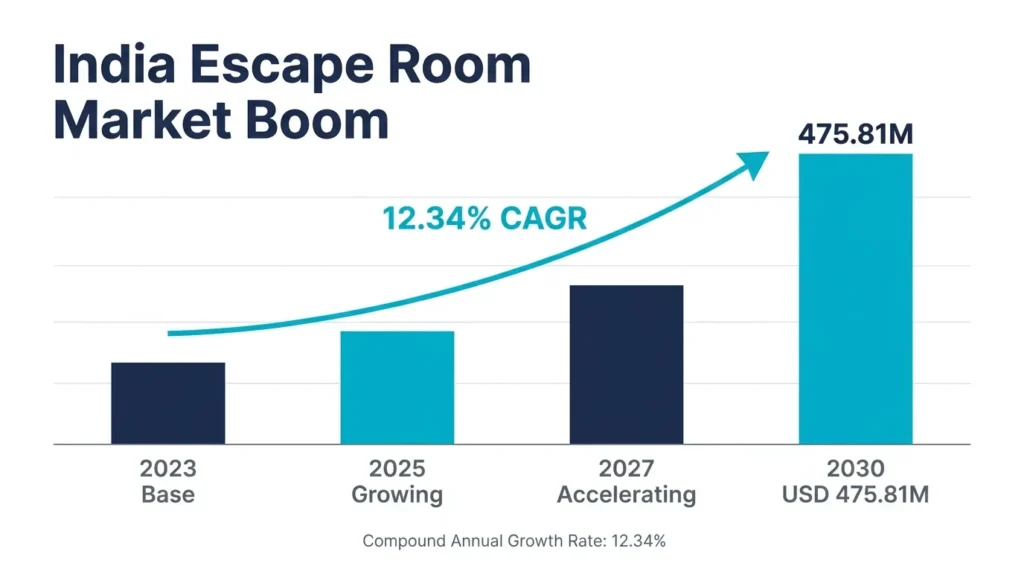
According to India escape room market projections, India’s escape room market is projected to reach USD 475.81 million by 2033. That’s a 12.34% CAGR. Sustained double-digit growth doesn’t happen in niche categories.
India Escape Room Market Growth Projection 2023-2030 – 12.34% CAGR
That number deserves attention.
A 12.34% CAGR signals genuine consumer and investor confidence. It means operators are expanding, not just surviving. The Asia-Pacific immersive entertainment market report places this region among the fastest-growing leisure categories globally. India sits at the core of that growth. Escape rooms specifically are outpacing broader entertainment sector averages across the subcontinent.
For Hyderabad, these figures aren’t abstract. The city’s demographics align almost perfectly with the core escape room audience. High-disposable-income young professionals concentrated in one geography generate consistent, repeat demand. What investors spot in national data, operators are already experiencing on the ground.
Hyderabad isn’t following this trend. It’s driving it.
Why Hyderabad Is Leading the Charge in Tier-1 India
The city’s tech corridor runs from Gachibowli through Madhapur to Kondapur. That stretch holds some of South India’s highest concentrations of salaried professionals aged 22 to 38. These are exactly the people who want interactive entertainment Hyderabad can’t easily offer elsewhere.
What gains traction here tends to spread across Tier-1 India. Hyderabad has consistently functioned as an early-adopter market for experiential entertainment formats. The immersive puzzle experiences building momentum here will shape what Mumbai and Bengaluru construct next.
The Technology Trends Actually Reshaping Escape Rooms Right Now
Technology is changing what’s possible inside a room.
The escape room format and adventure theme research points to format diversification as a primary growth driver. Adventure and mystery themes are expanding. But the bigger story is how technology is enabling entirely new puzzle architectures. Static set design is giving way to dynamic, responsive environments.
How AI Adaptive Puzzles Change the Game for Every Skill Level
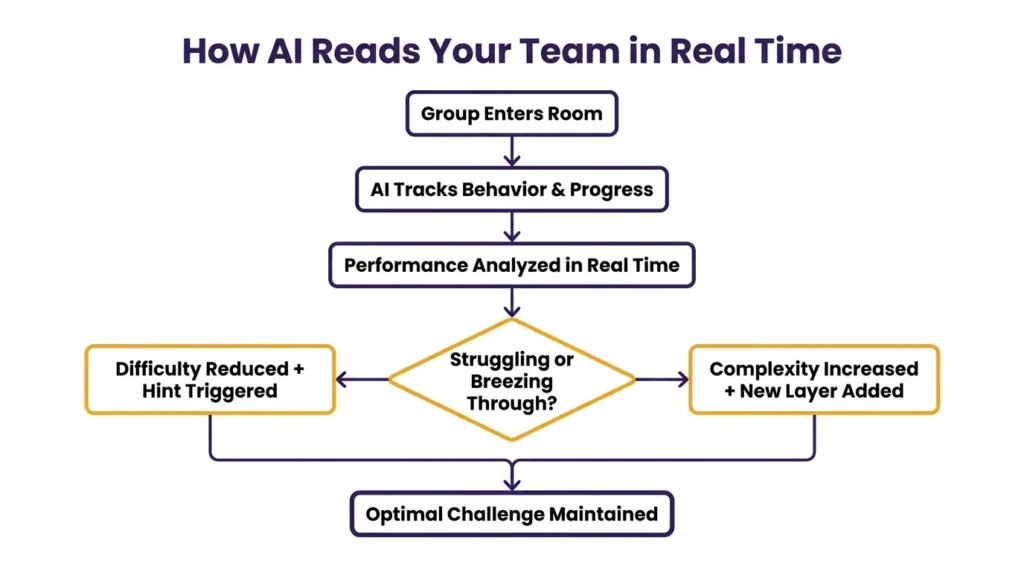
AI-powered adaptive systems track group behavior in real time, adjusting clue timing and puzzle complexity based on how a group is actually performing. A team of first-timers gets a fundamentally different experience than a group of seasoned players. This cuts the frustration drop-off that kills repeat visits. Beginners don’t feel lost; experienced players don’t feel bored. According to AI-powered escape room design, this adaptive approach is genuinely reshaping how rooms get designed.
How AI Reads Your Team in Real Time – Adaptive Puzzle System Flowchart
About where India sits right now? Most venues haven’t implemented this yet. Honest truth.
Early adoption is happening in a handful of markets, and India is watching closely. The operators who build this infrastructure now will own the premium segment when demand scales.
Full AI-adaptive rooms are still emerging here. That window won’t stay open long.
IoT Triggers and the Death of the Padlock Era
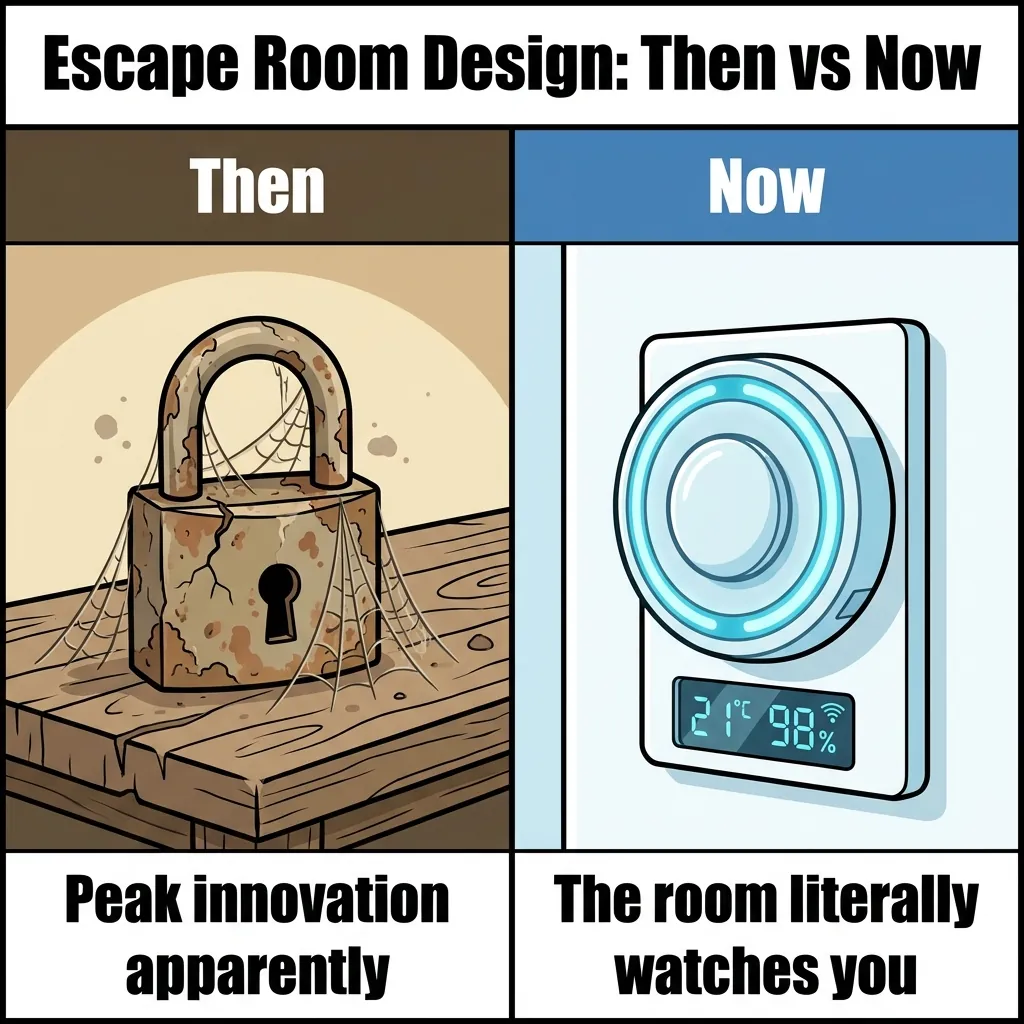
IoT-connected sensors and smart locks are replacing static padlock puzzles. Environmental triggers – lights, sound, temperature shifts – respond dynamically to group actions. This deepens narrative immersion in ways a padlock simply never could.
Physical padlocks are becoming a sign of outdated room design.
Escape Room Design: Then vs Now – Comic Meme Comparison
Puzzle states that shift based on what your group actually does create genuine replayability, meaning no two sessions feel identical. IoT puzzle triggers are the backbone of next-generation escape room narrative design.
Groups notice the difference immediately. The room feels alive.
VR Escape Rooms Are Coming to India but the Timeline Is Honest
VR escape rooms eliminate physical space constraints entirely.
You might be skeptical about VR timelines. Operators have been talking about full VR rollouts for years without delivery. Hardware costs and maintenance remain significant barriers in India, and most venues lack the infrastructure or the budget to run full VR at scale. Hybrid VR-physical rooms are the more realistic near-term format.Experts predict that widespread VR adoption in India will occur within the next few years.. That’s not pessimism. That’s an accurate read of where costs and consumer readiness actually sit.
Horror and Live Actor Formats Are Growing Fastest – What’s Driving It
Why Audiences Are Picking Fear Over Puzzles
Recent trends show that horror-themed escape rooms are becoming more popular than other genres in India.. The psychology isn’t complicated. Adrenaline and shared fear build stronger memories and tighter social bonds than standard puzzle-solving ever does.Research indicates that groups who experience fear in escape rooms are more likely to return.. Groups who experience genuine fear together tend to return. The adrenaline-reward loop is nearly impossible to replicate in other entertainment formats.
Corporate groups book horror rooms specifically because stress responses expose authentic team behavior. Families with teenagers pick horror because it’s genuinely memorable, not just a good time. Analysis of the horror segment’s growth reveals insights into audience preferences in entertainment..
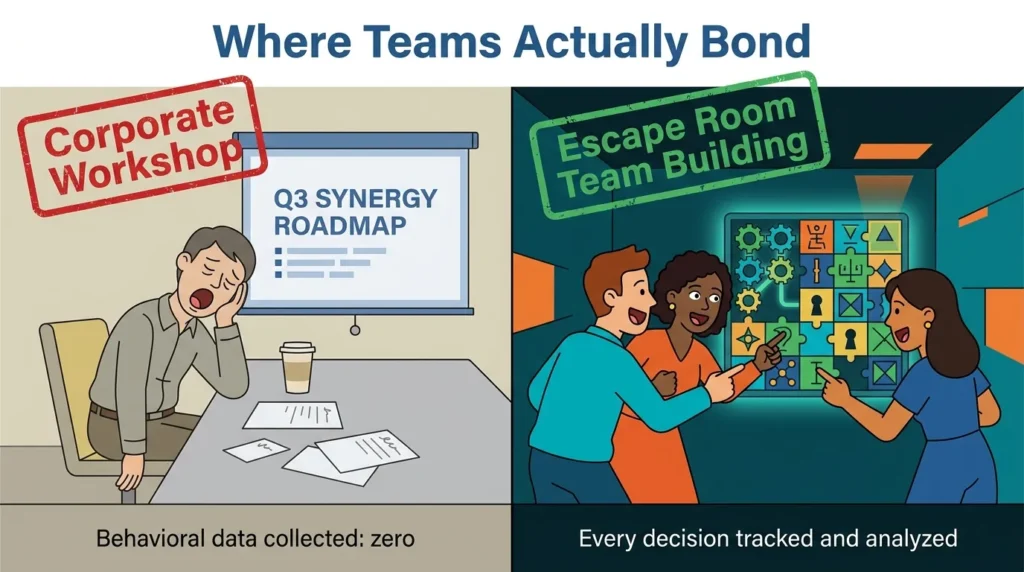
Escape rooms expose real team dynamics under genuine pressure. No facilitated workshop produces the same behavioral data. The debrief after an 80-minute room is often more valuable than the room itself.
Where Teams Actually Bond: Corporate Workshop vs Escape Room Team Building
The Live Actor Advantage No Algorithm Can Match
No AI system produces genuine human unpredictability. A live actor makes real-time decisions based on how your group is actually responding. That’s not scripted. Not programmable. (Admittedly, this also makes it harder to scale, but the experience payoff is substantial.)
The industry is moving toward more human-in-the-loop experiences, not fewer. Operators who grasp this aren’t swapping people out for tech. They’re using tech to amplify what human presence already delivers.
Corporate Team Building Is Becoming the Engine of Escape Room Growth
What an Escape Room Reveals That a Workshop Never Will
Escape rooms expose real team dynamics under genuine pressure. No facilitated workshop produces the same behavioral data. The debrief after an 80-minute room is often more valuable than the room itself.
Companies like Google, Amazon, and Microsoft haven’t used team building escape rooms Hyderabad purely for entertainment. They use them to watch how teams actually communicate under ambiguity. Leadership emergence inside a room is authentic, nobody is performing for a facilitator. The pressure is real, the clock is real, and the decisions people make reveal things a personality assessment never captures.
Gachibowli and Madhapur together form one of the densest concentrations of corporate offices in South India. Shell, LinkedIn, Apollo Hospitals, Tata ELXSI, Genpact, these aren’t small teams with small budgets. Corporate demand at this scale is pushing operators toward longer formats, stronger narrative design, and more sophisticated room mechanics. The interactive entertainment Hyderabad’s tech corridor expects is directly funding the next generation of escape room design.
That repeat behavior is what’s pushing operators to invest in longer, more complex rooms.
HR budgets for experiential team-building are expanding post-pandemic. Companies want activities employees won’t groan about.
Why Hyderabad’s Tech Corridor Is a Corporate Escape Room Goldmine
Gachibowli and Madhapur together form one of the densest concentrations of corporate offices in South India. Shell, LinkedIn, Apollo Hospitals, Tata ELXSI, Genpact, these aren’t small teams with small budgets. Corporate demand at this scale is pushing operators toward longer formats, stronger narrative design, and more sophisticated room mechanics. The interactive entertainment Hyderabad’s tech corridor expects is directly funding the next generation of escape room design.
What the Next Five Years Actually Look Like for Escape Rooms in Hyderabad
Longer Formats and Deeper Stories Will Define the Premium Tier
The premium segment will compete on story depth, not gadget count. A 45-minute room delivers a puzzle. An 80-minute room delivers a narrative arc with real tension and resolution. Operators who invest in escape room narrative design now will own the premium tier when the market matures. The future of escape rooms in Hyderabad runs through longer formats and richer storytelling.
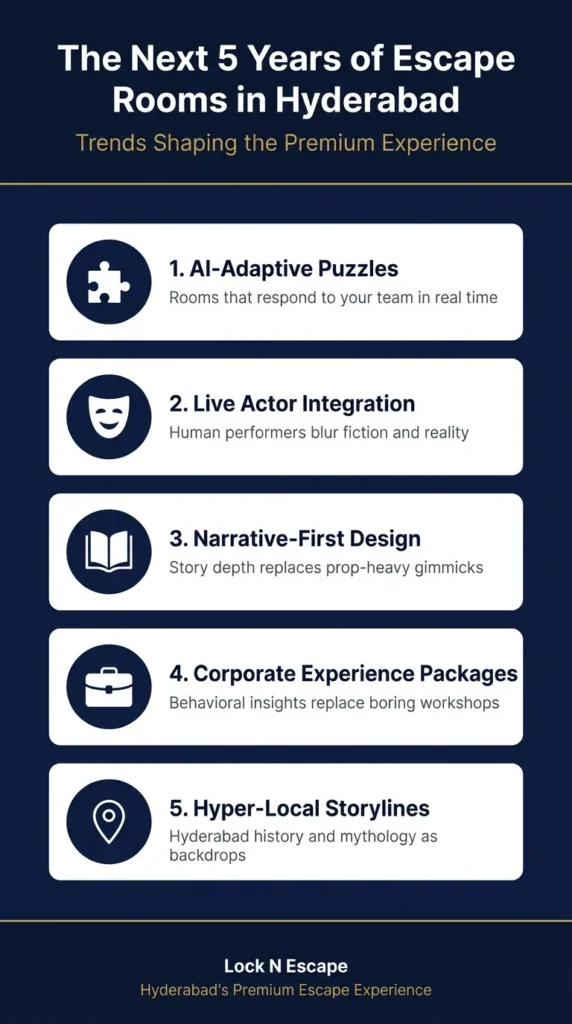
The Next 5 Years of Escape Rooms in Hyderabad — Trends Infographic
That’s not speculation. The market data already points in this direction.
Birthday parties, anniversary celebrations, and social occasions are pulling in audiences well beyond the usual friend groups and corporate clients. Birthday party escape room Hyderabad searches are climbing because parents want venues that keep mixed-age groups engaged for two to three hours without descending into chaos.
Families with kids aged 10 to 16 represent a significant and underserved segment. Operators who build rooms accessible to this audience will capture demand that currently has nowhere good to go. That diversifying audience is one of the clearest signals escape rooms have moved past niche status.
You’re probably thinking this all sounds like a best-case scenario. Fair point. Not every operator will make the investment. But the ones who do will shape what immersive entertainment means in Hyderabad for the next decade.
The Human Element Will Stay at the Center Even as Tech Scales
Technology strengthens the best escape rooms. It doesn’t replace what makes them work. Over-engineered rooms risk losing the social, collaborative core that drives repeat visits and word-of-mouth. (Trust me on this, I’ve watched rooms so packed with tech that groups forgot to actually talk to each other.)
Lock N Escape’s 80-minute rooms and live actor format represent the present-day version of what the industry is building toward. If you want to experience where the future of escape rooms in Hyderabad is heading, that version is already operating in Banjara Hills. The future isn’t fully here yet. But a meaningful piece of it is.
Conclusion
India’s escape room market is growing along a clear, data-backed trajectory, and Hyderabad sits among its most active testing grounds. Technology will keep reshaping the experience, but the human core (the pressure, the collaboration, the shared story) stays central.
Hyderabad is already living an early version of immersive entertainment’s future.
The best moment to witness where this industry is heading? Right now. Book a room, bring your team, and see what the next five years are being built on.